
South Jordan - through the back entrance


We are still sleepy standing in the line at the airport gate. Snorkel goggles on our heads and thick sleeping bags around our necks proudly announce: we are not preparing for an average tourist tour. And for this kind of adventure, the small bag -that can be taken on board- is too little. I realize only in the fragrant heat of the runway in Aqaba, that this trip made on a sudden impulse will not be an everyday stuff: walking in the desert + winter diving. All this for twenty thousand hungarian forints ( including the plane tickets).

The entry stamp is given without a word, Aqaba is a duty-free area that can be visited without a visa. Nine disappointed taxi drivers watch as we walk towards the nearby town, but the bizarre triumphal procession ends soon , unfortunately the first military checkpoint is only accessible by car. The lucky driver kindly offers a can of water and tries to ask in broken English: -Is it your last time in Jordan?
We really hope not, although it is obvious that he is working on it, because he does not specifically look at the road while driving, and it is only thanks to a firm jerk of the steering wheel that we do not run into the sedan in front of us.
Buying our food for the week, we go through the first culture shock, chaotic traffic, honking instead of priority on the right, garbage everywhere, shopping carts scattered on the sidewalk, all food wrapped in unreasonably massive plastic, except for oranges, in exchange they are rotten... Roasted chickpeas replaced the tent in the sack, pistachio halva and some cucumbers are taken over in the backpack, which swells from thirty liters to seventy due to the hiking stuff that has now been hanged outside. We head towards the beach, taxi drivers in the center spot us from 100 meters away, park in the inner lane at the roundabout and wave at us through 3 rows of hedges, but the situation is no easier on the beach: every second person from the age 12 to 80 offers a boat trip, the first word for jordanian kids is probably "glassboat", the second is certainly "special prize".
Leaving the port and the flagpole rivaling the height of the Hungarian Parliament, we head towards South Beach, apart from us only a few stray dogs and a man in a visibility vest are lounging on the roadside bench. Garbage bag in hand. He can be the local Don Quijote because he picks up - no matter how incredible - rubbish. However, the bag would already be full in an randomly selected thirty-meter section, so with foresight, he only throws every eighth piece of garbage into the nylon.


The beach, known as a diving paradise, gives a bleak impression both at first and second glance, it's hard to imagine that there could really be anything interesting here, but as soon as we put our heads in the Red Sea, our mouths would be left open if it didn't immediately fill with salt water. Among zigzag coral reefs, we come across colorful fish of all shapes and sizes, crabs, mussels and even a few sea turtles and rays. The water is not too cold even in January, but after an hour of snorkeling, we get quite cold. We spend the first two nights camping on the beach in the free campsite designated here. Comfortable sand, lighting that puts stadiums to shame, squatting toilets, 0-24 police supervision and 0-24 Arab revelers make the place comfortable, only stray dogs loitering half a meter away from the tent disturb the night's rest. We are out of season, there are hardly any tourists, almost only locals walk on the beach, smoke hookah or pray towards Mecca, and then we are invited to some delicious tea. Saturday morning idyll.
After the diving days, we set out for the less diverse, but even more exotic desert landscape, following the Jordan Trail hiking route, about 75 km from the coast to Wadi Rum. The landscape here is a complementary set of the underwater Garden of Eden, we start overcoming the 1,000-meter difference in level in a barren wasteland. At first, the path leads through tunnels of highway culverts and barbed wire fences of industrial estates, then crossing the first pass, the desert silence slowly takes the place of the last dog barking. Only the force of gravity reinforced by 6 liters of water and a few discarded pet bottles remind us that we are not walking on the surface of a distant and uninhabited planet.

We set up the tent in a narrow valley, our dinner is bulgur cooked on a campfire and cucumbers peeled with scissors. The next day we cross another pass and reach the first ( which is officially the last) camp of the Jordan Trail, a solitary Bedouin tent with two camel saddles and a stick thrown aside. We take it. The name ‘hiking trail’ is a bit of an exaggeration here, we cross the stone desert mostly with the help of GPS or following camel tracks. After two days, we meet the first humanoid creature, a Czech guy. With only a 15-liter backpack, without any sleeping bag and sleeping mat, he covers the same distance as us in sandals (with socks). His ears stick out from the cap, maybe to hear better or to evaporate, we don't dare to ask, in any case, this must be a true evolutionary adaptation to the desert conditions.
On the third day, we reach the village of Tutun. Goat sheds made of tin sheets, scraped carpets and pieces of wires, houses built of formwork concrete, trash cans with standardly broken wheels and three camels, one of them is dead. The other two are not very active either, with an apathetic expression on their faces, wondering about the ultimate question of "life, the universe, and everything". However, we are aware of the mission: we have to get some water. Only two human can be seen on the street, an older man washing cloths in a dirty bowl, and an elegantly dressed younger man - probably his son - who just then gets out of his luxury SUV. The contrast could not be sharper. The old man doesn't seem to take notice of us, the young guy fills our bottles without a word from a worn-out water tank.
Lunch will be eaten under a solitaire acacia tree. Choosing the supermarket was a mistake, all the food is moderately horrible, with basically three ingredients: sugar, salt, sugar. Roasted chickpeas turned out to be the least practical choice, crushed into powder between the teeth, it removes the remaining moisture from the mouth of the tired hiker, and once it reaches the digestive system, cellular osmosis takes an u-turn.


We're close to the famous Wadi Rum, where the mountains are replaced by sandstone mountains eroded to a stalactite-like form, and any random rock imported into Hungary would immediately make it into the top list of national attractions. In the distance, disabled aliens stride strangely. Camels, in harness. Not a green plant anywhere, we can't imagine what they could eat in this desolate desert, and from their facial expressions we can tell they don't either. The surreal atmosphere is amplified by a strange folklore show: Bedouins grazing goats by jeep. On the back of the truck, a ten-year-old child screams in a steady rhythm, his father's plagiarising Chubakka's grunts making the rock walls ring as if they were herding the flock with echoes. Petrol must be very cheap around here, because the meagre calories the goats take in hardly compensate for the fuel they use up in the meantime.


Slowly we reach the tourist hotspots, there is hardly any untouched area in the sand, every attraction is connected to every attraction by a car track, so the whole desert reminds me of that incomprehensible skipped graph problem from the maths exam. The better-known tourist attractions are usually disappointing, and in Khazali Canyon we can't find the 'birthing woman' rock carvings, although the two stones they step on to help bring their offspring into the world must have been a major achievement of the early cultures living here, if they thought it so important to depict them.
Whereas the southern part of Wadi Rum was characterised by rounded rock formations of whitish sandstone, further north the towers are steep and glow red in the setting sun. After the majestic spectacle, we continue our walk under the stars, and discover that the ancient Greek sailors must have overdose the ambrosia wine, because from of all the constellations, only the Rabbit (Leporis) bears any resemblance to its eponymous animal.

We wake up at the top of an 80-metre-high sand dune in the morning, still undecided whether the 45-degree descent in the dark or the epic sunrise is more breathtaking.
Although the tourist map here promises more rock paintings, the prehistoric practice of childbirth is not to be stolen this time either. Around noon, we wearily roll into the heart of the place, Rum Village, where we are greeted by a post-apocalyptic setting. A cloud of dust, broken-down cars on the side of the road, rubbish fences, an orphaned engine block, children carrying gas cylinders, all accompanied by the roar of camels and the rattle of dying goats. After refilling our cucumber reserves, we spend the next night in a local guide's house. The accommodation is immaculate, although the mattresses are covered with pieces of paint dripping from the ceiling, there is no heating and the bathroom lacks a window, just an empty hole, but all this is offset by the kindness of our host, the English toilet and the lush lemon trees in the courtyard.


The afternoon is spent observing local daily life, with the men busy telehealing a burst water pipe. The village receives water every two days, which is delivered to the houses in plastic pipes carelessly dropped and laid across the street, above the ground and the water spraying from the leaking pipes on walls, fences and clothes, making the network look more like a football field sprinkler system. Dodging goats in the street, we pass a few broken-down 4x4s and a building with a collapsed roof, the local mechanic's workshop. Its neighbour is a coffee shop, but the owner, cleverly realising the connections, has a multi-business profile, and in addition to coffee and tea, there are also barely used toilet cups on offer.
We talk to a young guide, and after some general questions, we move on to the topic that interests us most: how young people meet here and how the dating process works when we can not see any girls on the streets. He answers readily: according to the local custom, the young man's female relatives check out the girl, then they go for a visit with their whole family, where the youths talk for 5 minutes and then the girl is asked if she wants this marriage. If the answer is yes, the wedding is celebrated by men and women dancing in separate places, with only the young couple leaving the meeting after dark (for the second 5 minutes).


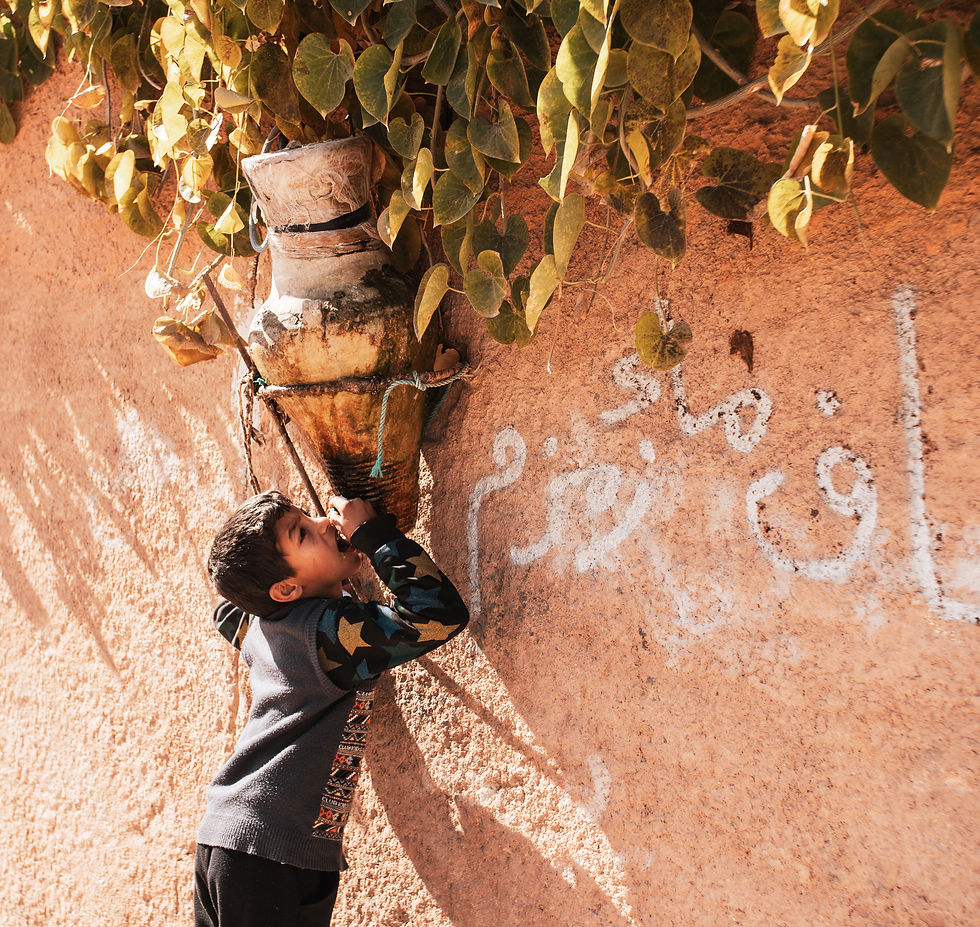

On the street, everyone is generally friendly, direct and helpful, as if you can feel that they pray five times a day (except for the taxi drivers, who seem not to). We find it a bit strange that they always ask about our sticks first of all. The next day, our hostess, pointing to my sister's cane, laughs and says he knows where we got it from, and we are left with the unsolved mystery of how the whole desert knows about this unremarkable piece of wood, abandoned in a tent in the middle of nowhere. In any case, we leave the mythical trekking tool behind, with only a few obligatory camel hump-smelling incense burners in the bag as souvenirs.
We regenerate our burnt-out culture shock receptors in the village by visiting a mountain spring, a real oasis with moss cushions, nettles and fragrant wild figs. Without a single tourist. We continue climbing in the horns of the deserted canyon, with not a human trace to be seen beneath the huge rock walls. Finally, a scratching of a "woman giving birth between two camels" makes up for the rock paintings we didn't find, as if I had just petrograffitized them, I hope this new archaeological discovery doesn't fundamentally shake the identity of the Jordanian people.


We wake up to the sound of crackling loudspeakers on the last jordan morning, the eerie echo of the muezzin calling to prayer settles slowly between the rock walls of the wadi, and we, shivering in our sleeping bags speckled with bits of plaster, half asleep, feel that we will return to this sweetly interesting country, but only if we survive the taxi ride to the airport..


Comments